|

News articles, columns, book
reviews and more.
printer-friendly
version
David Frost BBC
Interview with Dr. George Carey
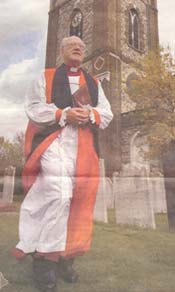
BBC BREAKFAST WITH FROST
INTERVIEW:
DR GEORGE CAREY, ARCHBISHOP OF
CANTERBURY
OCTOBER 27TH, 2002
DAVID FROST: Now today,
Dr George Carey is preaching his last sermon as Archbishop of
Canterbury. He is stepping down on Thursday, after eleven and a half
years in an exhausting job. I visited Dr Carey as he prepared to
leave Lambeth Palace, we talked about many issues that he has faced
during his time as the spiritual leader of 70 million Anglicans
world-wide. We talked about the possibility of women becoming
bishops, the ordination of gay priests and how his successor Rowan
Williams will take the church forward, but we began by talking about
one of his main projects during his time in office, the decade of
evangelism. Was he disappointed that despite his efforts, fewer and
fewer people seem to be going to church in this country?
DR
GEORGE CAREY: Well it is a disappointment because I'd always hoped
that we'd impact on the numbers actually there on a Sunday. But I
think what we have to remember, that in the '90s we had the
deregulation of the Sabbath, and now look what happens to the
Sunday, when I walk out in Canterbury on Sunday, it's just like any
other day, whereas ten years ago it was much more peaceful. In other
words, the church is in a much more competitive arena these days.
The good news is that churches are now doing what I've been pleading
for it for ages, to be a seven day a week church -reaching out on
Monday as well as Sunday.
DAVID FROST: What about these
things where people say bishops should be more accessible and should
wear jeans rather than their usual outfits and so on - is that a
good idea or bad idea?
DR GEORGE CAREY: Well I don't
actually go along with that at all, actually. I mean take this dog
collar I'm wearing - does it get in the way? I don't think it does,
I think it's people that get in the way. The reason why I believe in
wearing robes in church is that I do believe that God is a great
listener, is worthy of adoration and praise and therefore by wearing
robes I'm making myself more anonymous so that people are not
looking at what I'm wearing, because they're used to the robes,
they're able to worship God. I went to a church quite recently and
I, it was a Sunday morning, and the chaplain taking the service was
there, didn't have a jacket on, he had a dog collar, brown shirt,
and I was distracted by it, you know, I just thought what a pity
that he didn't actually wear the customary robes of the church. So
that is unrepentantly my position.
DAVID FROST: That's the
position on jeans, on things like that proposal in Sydney,
Australia, at the moment, that lay people, perhaps because of a lack
of personnel, should conduct communions and so on – you wouldn't be
in favour of that either, would you?
DR GEORGE CAREY: No I
wouldn't actually - and the funny thing about Sydney is it's not
because of lack of people, it's a very vibrant diocese, I believe
it's - well I'll be cheeky, I'll say it's sloppy theology. I do not
believe it's Anglican theology to do that, we do believe that from
the laity certain people are set aside for the special ministry, we
ordain them, it's a very special function. And I think the Sydney
approach is wrong, I hope they don't go down that way because it
will cause a split in the Anglican communion but they know my views
on that very strongly.
DAVID FROST: What about the relation
of church and state? In terms of the situation now, I mean do you
think that we've just had an archbishop chosen, finally, by the
Prime Minister. Will that still be the situation until time
immemorial? Some people say that in a way it's almost
obsolete.
DR GEORGE CAREY: Well, let me slightly correct you
David, he was chosen really by the church. The church - DAVID FROST:
He didn't have to take the recommendation of the ...
DR
GEORGE CAREY: You're right about that. Two names were submitted, I'm
fairly confident that he took the first name offered by the church.
I believe the issue of establishment is an ever-changing issue.
Establishment today is not what it was a hundred years ago, no doubt
it will evolve and change in the future - I've often said I would
love to work towards a form of establishment which is shared by
other Christian churches in the land, but that has to be left to one
side for the time being.
DAVID FROST: ... said about being
of all faiths, the defender of all faiths.
DR GEORGE CAREY: I
believe that is what a free nation and what the monarchy represent,
if not represent all faiths but I think we are a Christian nation,
we should be proud of Christianity. The particular link to the
monarchy, all this, all these are part of establishment. I, I think
we would be the poorer if we lost that relationship.
DAVID
FROST: And knowing your feelings about inter-faith and so on, do you
think that the rule by which the heir to throne cannot marry a
Catholic? Is that sort of out of date?
DR GEORGE CAREY: No I
think it's one of the issues that have to be discussed. Part of my
view about an evolving establishment, things are ever-changing and
who knows what the future will hold.
DAVID FROST: Do you
think that's for discussion really?
DR GEORGE CAREY: That is
for discussion, it's certainly on the table, it's being
ignored.
DAVID FROST: And what is the Church's current
position to the idea of Prince Charles marrying Mrs Parker Bowles?
DR GEORGE CAREY: Well I think the position on that is that
we must wait and see what happens, David. Prince Charles has clearly
said that he has no intention of marrying, we take him at his word.
I am in regular contact with him and this matter hasn't come
up.
DAVID FROST: And the next coronation, however, will
involve many faiths, rather than just the Church of England - as you
see it, from what you just said.
DR GEORGE CAREY: Well I
think the next coronation, when it comes, I think it will have to
take into account the new situation, we're no longer a monochrome,
Christian nation, in which the Church of England predominated -
which was the case 50 years ago. We're now a multicultural society.
Now the form of the service of coronation will be largely in the
hands of the Dean of Westminster Abbey and the Archbishop of
Canterbury at the time.
DAVID FROST: But if it had happened
in your time, you would have wanted to bring in other
faiths?
DR GEORGE CAREY: Oh I would have wanted to make it
profoundly Christian, but also very accessible to other faiths, in
which they will be included and honoured and valued.
DAVID
FROST: And in terms of the House of Lords, do you think the other
faiths should have their equivalent of bishops in the House of
Lords?
DR GEORGE CAREY: Other faiths should be there and
ought to be there but of course ways that they're included can be
done in other ways than by having a constituency called Hinduism or
Islam. They can be brought in, as they are being at the moment, with
peers who are Muslim or Hindu.
DAVID FROST: Now everybody is
debating, as you've heard obviously, the question of women bishops
and issues like that. It does seem to people illogical in a way that
once you've got women priests, if they do well, why shouldn't they
get promoted like everybody else to be bishops.
DR GEORGE
CAREY: Yes it's not only that, and certainly that point of view is
one I welcome, but it's also, I think, on theological grounds as
well, stemming from our baptism, a woman is a child in the sight of
God and I believe her gifts should be exercised in the wider church.
Of course not everyone is going to agree. The Roman Catholic church
is not going to agree with that position either - that's why we have
to keep in step with our ecumenical partners. DAVID FROST: If we are
assuming that there's a likelihood of the consecration of women as
bishops in the next ten or 20 years - which I think we are, aren't
we, that's likely - and then in that particular situation we have
the irony that the two initiatives, one of which you masterminded,
the women priests, is as it were runs contrary to your passion to
bring together the Church of England and the Roman Catholic church -
it obviously makes it more difficult, which must have been a
schizophrenic moment.
DR GEORGE CAREY: Absolutely. That is a
very discerning point of view because in 1991, when I realised I had
to handle that issue, there was part of me which said I'm so
committed to the unity of the church, this is breaking faith with
it, nevertheless, the Church must find its own way, it must keep its
eye on the big picture, it must value and honour women and draw
women into positions of responsibility that they are worthy of - and
there's some pretty able women out there in our church and I'm
delighted.
DAVID FROST: In terms of the situation on gay
priests and so on, 1998 you managed to achieve a consensus about it,
the only legitimate context for sex is heterosexual marriage, and
that therefore a practising homosexual could not become a priest but
a non-practising homosexual could. Do you think that position will
hold?
DR GEORGE CAREY: I think the issue of homosexuality -
and I do respect homosexuals by the way and I've got many friends
who are homosexuals, they know I disagree with practising
homosexual, they know I do not want practising homosexuals in the
priesthood, they're well aware of that, but it's a debate that is
still going on. I'm not silencing the disagreement and the debate -
it must be with us because homosexuals are people, made in the
likeness of God, so we have to treasure them.
DAVID FROST:
And in fact we've got a situation where two Anglican dioceses, one
in the US and one in Canada, are about to bless same sex unions -
that presumably you would feel not helpful?
DR GEORGE CAREY:
I don't believe in blessing same sex relationships because frankly I
don't know what I'm blessing. That is one of the issues we need to
look at, we need to look at the kind of language, what we're trying
to do.
DAVID FROST: So really that Mayor of London's
register, Ken Livingstone's interview where same sex couples can
make their commitment to one another, you'd rather he hadn't done
that?
DR GEORGE CAREY: Of course. But I've got to say that
there may be things that civic society may do that the Church may
not wish to follow or bless.
DAVID FROST: You're in the best
position to do this, what would be your message to your successor?
DR GEORGE CAREY: I'd want to say to Rowan, enjoy the job,
because if you can't enjoy it then you ought not to be doing it.
It's very demanding work with many opportunities to make a
difference. He will come with many excellent gifts, he is a very
profound theologian, and he will have an opportunity now to share
his teaching ministry with others.
DAVID FROST: Everyone
says he's more liberal than you, is that true?
DR GEORGE
CAREY: When people try to insinuate that he's somehow in a different
part of the church from myself, I would say no, imagine it's rather
like a huge cricket team, I'm, I've had my innings, I'm going out,
and 104th batsman - it's a large cricket team you see - he's coming
out to take his position at the crease. And I'm saying to him, God
bless you, good luck, stick in there.
DAVID FROST: And will
the new captain change the tactics, change the bowling?
DR
GEORGE CAREY: Ah, this is where the metaphor goes all awry, because
who is the captain? There's only one captain in this kind of cricket
team - the one up there. And we'll be praying for Rowan and Church,
the Church will remain united, committed to the big picture, looking
out into our society, not letting our internal quarrels get in the
way.
DAVID FROST: Thank you very much.
DR GEORGE
CAREY: Thank you.
INTERVIEW ENDS
The interview comes
courtesy of "BBC Breakfast with
Frost".
|